All my favourite things


Photographer Unknown.


Simple, but so beautiful. This work breaks my heart.

It's a very simple idea, one that my own Dad practices...every season of every year, he takes a picture of the front of the house and then one of the back garden. We make fun of this little tradition, but I bet in the future, I will treasure them.

As i wrote in my 'Plein Air' project Critical Appraisal, the countryside is often seen as the perfect place for retirement, which seems curious when we consider how lush natural surroundings can constantly remind us of the passing of time, the changing of seasons, endless regeneration.

Flowers in particular, are capable for inducing such feelings of repose. The Victorians invented their own language of flowers, enabling shy, retiring (or rather, stiff upper lipped!) people of the era to leave secret messages for others. Even the recognizable scent of a particular flower, plant or perhaps a scented handkerchief sent its own unique message.

As the V&A archive states:

"There was a great vogue in the 19th century for images that depicted idealised rustic or seasonal settings. This is often interpreted as an escapist response to the upheavals of urbanisation and industrialisation. Many Victorian artists also specialised in sentimental interpretations of the historical past, producing works that were emotionally resonant but rarely true to period. The concept of one's personal past also formed part of visual imagery, with a focus on the more poignant life events: birth, childhood, marriage and death."

Another great reference to floriography, are etchings by Victorian writer/illustrator Jane Loudon. She was to Victorian gardening what Mrs Beeton was to cookery! Her beautifully illustrated books on gardening and plant identification sold in their thousands and women all over the country were enthused enough by them to take up gardening as a hobby. Her greatest work 'Encyclopaedia of Gardening' was a collaboration with her husband. They began to work together on John's books and in their own extensive garden.


Jane Loudon (1807-1858)
‘The Ladies’ Flower-Garden of Ornamental Annuals’


Jane Loudon (1807-1858)
'The Ladies' Flower-Garden of Ornamental Annuals'


Jane Loudon (1807-1858)
'The Ladies' Flower-Garden of Ornamental Annuals'


Jane Loudon's influence is difficult to exaggerate. She made gardening accessible and managed to communicate her own enthusiasm in a very practical, useful way. Through her books, gardening came to be regarded as a recreational activity for everyone.

For anyone interested in reading into the Victorians themes of nature, i recommend "The Victorian Flower Oracle: The Language of Nature"

Perhaps, spending your time creating a beautiful garden at your family home is a similar message of love and devotion? Even in these photographs set during winter, the path is kept swept clean, and the flower beds kept tidy. Even in the last image of the gentleman standing alone, he leaves a space on the path for her.

Perhaps living in a more rural environment enables the understanding of this relationship between humans and the natural world, and brings a sense of satisfaction. It constantly allows you to recognise the omnipotence of the natural world, being surrounded by such burgeoning life acts as a reminder to enjoy every moment.

Rememberance


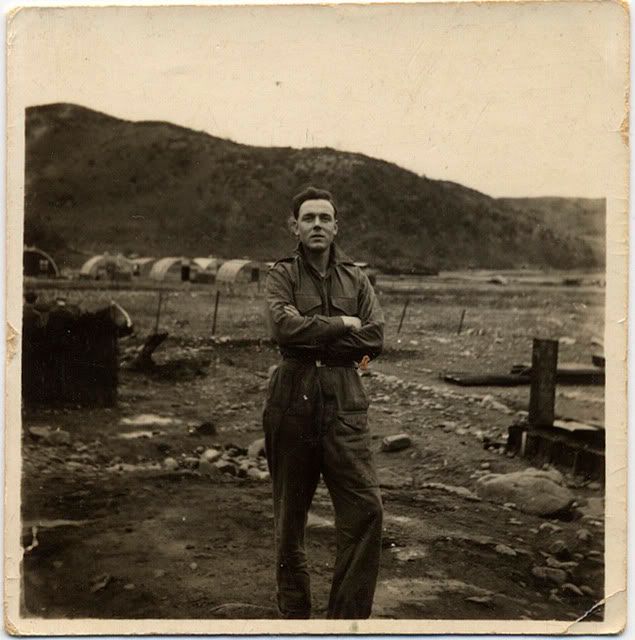
One of own my collected photographs, Unknown Soldier.

My family has a long history of being in the Army or Navy, and with my Grandparents both having great involvement in WW2, I have always been fascinated with the 1930s and 1940s. I am currently in the process of researching my families involvement, and my local war history, as I am considering a project based upon these experiences.

Living in Aldershot all my life (despite my constant moaning about it) has also provided me with some great military history and knowledge. During the recent years, it has become a ghost town, but in the 1920s-40's it was a thriving military town, with American, Canadian and Dutch soldiers all being stationed at the barracks.


Soldiers arriving at Aldershot Station, 1942.

During my time at Farnham College, we took a trip to the Western Front Battlefields, where we visited the graves of boys who attended the Farnham Boys Grammer school. One was only 15 when he died- Rifleman Valentine Joe Strudwick from Dorking in Surrey. He was one of the youngest British casualties of the Great War. The names of 5 more boys from Farnham could be found on the monument of The Somme Battlefields - M. Heywood, T.Hine, M. Hopwood, W. Jones and S. Spencer.

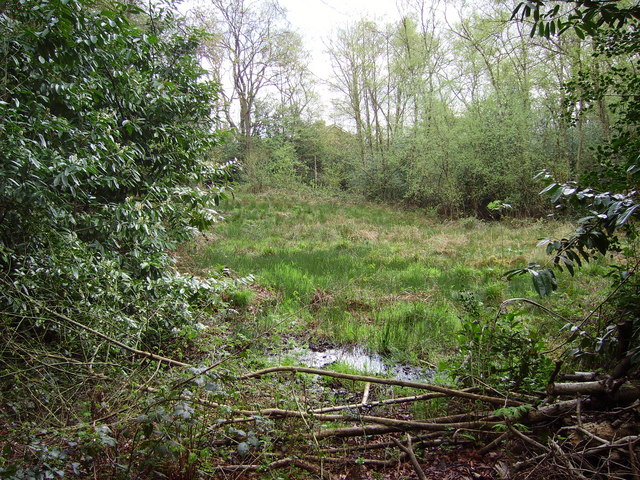
Continuing these local findings, there are 2 large bomb craters in Rowhill Copse (opposite my house) that were left from an air raid in July 1940. They can still be clearly seen today, and were recently featured on Channel 4's "Blitz Street" program.


Rowhill copse, Diane Sambrook

The first bomb fell on Surrey on the 30 June, 1940. From 30 June to 31 December 1940, 5,668 high explosive bombs were dropped on the Surrey area.

I plan to take a trip to the Aldershot Military Museum very soon, to go through their photographic archives. My Grandad's efforts in Burma are also featured in the Museum collection, so i feel it would definitely be a beneficial visit. My Grandparents never really talked about their experiences, and this seems to be common behaviour. How much do we really know? However, the few stories I did hear, have always stuck with me. They are so frightening, I can barely believe them to be real.

During our Farnham College Battlefields tour, one visit I vividly remember was to the Hindenburg Line, where the war poet Siegfried Sassoon managed a single handed capture of a trench. We learned this 'mission' was actually a suicide attempt. His own depression and despair provoked such manic courage, and his fearless nature gave him the nickname "Mad Jack" for his near-suicidal exploits.
Sassoon’s use of bitter sarcasm and graphic imagery make him one of the most moving and provocative of all the war poets, read "The Attack". This poem captures the terror of men caught in a mechanised war. Sassoon doesn't hold back on the horrifying details.


Sasoon's trench on the Hindenburg Line

Despite his best efforts, he survived the war, and made it back home. On his gravestone reads a prose from his great friend, and fellow poet, Wilfred Owen "My subject is War, and the pity of War. The Poetry is in the pity."

Wilfred Owen sought out Sassoon to teach him how to be a better poet, as he didn't have the self confidence to publish his poetry alone. Hard to believe such doubt. It only takes one read of "Dulce et Decorum est" to really put things into perspective.

For Rememberance day, Cambridge University Library is displaying their collection of Sasson's archive.


(Siegfried Sassoon's notebooks)

The Dug-out

Why do you lie with your legs ungainly huddled,
And one arm bent across your sullen, cold,
Exhausted face? It hurts my heart to watch you,
Deep-shadowed from the candle's guttering gold;
And you wonder why I shake you by the shoulder
Drowsy, you mumble and sigh and turn your head...
You are too young to fall asleep for ever;
And when you sleep you remind me of the dead


Sassoon became a pacifist, and upon the conclusion of his convalescence in the summer of 1917, he refused to return to war, penning a widely-published open letter, entitled “Finished with the War: A Soldier’s Declaration,” to his commanding officer. The letter concluded:

“I have seen and endured the sufferings of the troops and I can no longer be a party to prolonging these sufferings for ends which I believe to be evil and unjust. I am not protesting against the conduct of the war, but against the political errors and insincerities for which the fighting men are being sacrificed.

On behalf of those who are suffering now, I make this protest against the deception which is being practised upon them; also I believe it may help to destroy the callous complacency with which the majority of those at home regard the continuance of agonies which they do not share and which they have not enough imagination to realise.”


If you are interested in reading more about Sassoon, Wilfred Owen and the lives of such other Great War Poets, i suggest 'Regeneration' by Pat Barker. Also, my favourite book of all time "Birdsong" by Sebastian Faulks.

I am continuing my research of this era, this is only a small insight, as i thought the timing was appropriate. This week, I hope you've taken a moment to remember those who have died in wars throughout history, and those who are out there fighting right now.

To finish, Phillip Larkin's "MCMXIV", one poem that captures the aftermath of such horror, the wondering of how can we ever recover from such devastation?

Those long uneven lines
Standing as patiently
As if they were stretched outside
The Oval or Villa Park,
The crowns of hats, the sun
On moustached archaic faces
Grinning as if it were all
An August Bank Holiday lark;

And the shut shops, the bleached
Established names on the sunblinds,
The farthings and sovereigns,
And dark-clothed children at play
Called after kings and queens,
The tin advertisements
For cocoa and twist, and the pubs
Wide open all day;

And the countryside not caring
The place-names all hazed over
With flowering grasses, and fields
Shadowing Domesday lines
Under wheats' restless silence;
The differently-dressed servants
With tiny rooms in huge houses,
The dust behind limousines;

Never such innocence,
Never before or since,
As changed itself to past
Without a word--the men
Leaving the gardens tidy,
The thousands of marriages
Lasting a little while longer:
Never such innocence again.


Thanks for reading.