Showing posts with label victorian. Show all posts

Gents in the Garden - Vintage Photographs


These gentlemen are the newest additions to my 'In The Garden' collection, all Ebay finds! 
The first image is probably the oldest original print I own, it's nearly 10x8 in size and is quite stunning, despite it's damage! Really, I want to frame it and enjoy it properly - what a proper beard eh? I believe it to be a Victorian example, if you think i'm way off do let me know, but apart from his own style, the greenhouse behind him is quite telling! The second one is certainly a proud-between hard graft-shot, and as for the last one, well, a vicar in a greenhouse - need I say more?

I hope you've seen at least some of this gorgeous sunshine this week! I have so much to crack on with in the garden now, it's hard knowing where to start, so I'm starting out right after I finish typing, honest!

Katie 

OH! And due to Google Friend Connect soon becoming obsolete  I've signed up to Bloglovin to ease the transition! 
Follow on Bloglovin

Book Review - 'Britannia's Daughters: Women of the British Empire' By Joanna Trollope


I've been meaning to start writing book reviews for a while, and inspired by blogger-pal LandGirl1980's great selection of reviews, I am starting this habit right now!

I have been recently disappointed by several books regarding women's history. Being such a wide-ranging and vibrant subject, I can't understand why some authors seem unable to produce any narrative! Instead they just rely on constant lists of names with no context on WHY we should care about these characters (I didn't want my first review to be a negative one, but expect an example soon!)

I am glad to say, 'Britannia's Daughters: Women of the British Empire' proved most-readable.
I'm not sure I agree with the reviews of "Gripping...unputdownable" but certainly a very lively approach to describing the women who signed up to escape in search of opportunities and adventures they couldn't have at home. I particularly enjoyed the inclusion of fun and lighthearted family photographs which help add gravitas to the women's choice to leave their home and family behind.

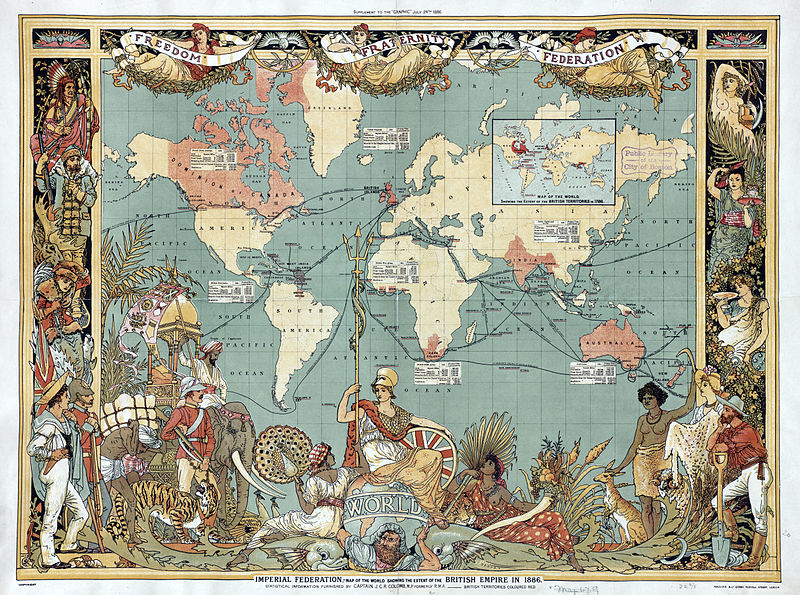
Map of the world showing the extent of the British Empire in 1886

I think the books strongest point is its broad-range of study regarding the social classes of the time. I think many imagine those who left to join "The Empire" enjoyed a life sipping a G&T whilst riding an elephant and brandishing a parasol. A dark truth we discover in the later chapters, is the deportation of women to the "uninhabited lands" of America, and eventually Australia in ships so cramped that a 6x6 foot space was deemed more than enough for four bodies. Their crime? Moral- Victorian England's worst nightmare...prostitution. Not something that would automatically spring to mind is it? They didn't send them to the "productive" lands of India (which already had a vast issue with prostitution) instead stuck to a typical "out of sight, out of mind" approach, shocking.

"Every woman is a nurse" is a fantastic chapter, describing to us the horrors of Victorian hospitals being no place for 'respectable' women (and rife with alcohol problems apparently) and the great change which followed when The Nightingale School of Nursing was set up. An important change swiftly followed around the empire, as finally women could be treated by their own gender, and stop being ashamed to discuss their situation or maladies. And for some of the doctors and nurses themselves who had lived previously sheltered and privileged lives, they now had to adapt to a whole new culture without the protection of their male family...and it would seem many relished this adventure! A particularly good quote from Dr Ellen Farrer, writing from India in 1891 describes the resolute self-sufficiency of each working day:

"Woman with dropsy arrived from Dadri on a camel. Cut orange peel for marmalade...went to see the postmaster's daughter, she has hysterics...Thirty five patients at dispensary...snake killed in Annie's bedroom"

My particular reason for picking up this book was because I hoped for stories about the female naturalists and plant-hunters who braved the jungles and highest mountains to bring back examples of previously unseen flora&fauna. I wasn't disappointed exactly, but I think a longer chapter could have been dedicated for Marianne North (who dedicated her life to painting plant specimens), Mary Kingsley (writer and explorer, particularly known for her work in Africa) and Margret Fountaine (Diarist and natural history illustrator). I think slightly too much detail was put into the darker/seeder side of women in the empire and not enough into the truly wild and colourful stories of the women explorers. There are some fantastic photographs of these women and their work at least, so it's best seen as a suitable introduction. I will be on the look-out for a more in depth study of these heroines soon!

 
Marianne North travelled the globe painting plants in their natural habitat

Marianne North - A Selection of Flowers from Mount Wellington, Tasmania (1880s)

So I would personally give "Britannia's Daughters" a 7/10. It's more of a lively-introduction than an in-depth history, and it did leave me with some questions. However, the chapters relating to the medical history was VERY informative, and has opened my eyes to the brutal truth surrounding womens missions abroad.

Thanks for reading!

Katie

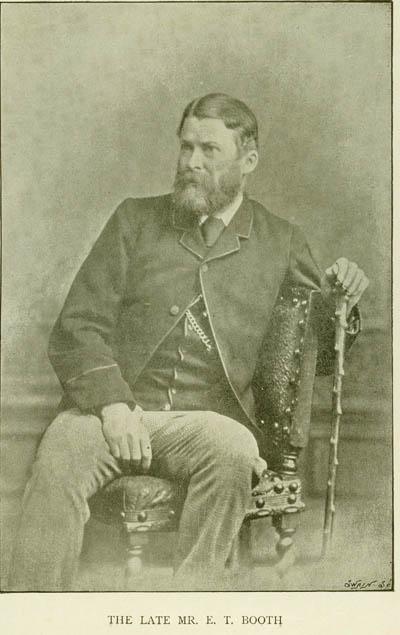
The Booth Museum Of Natural History


During my recent trip to Brighton, I visited The Booth Museum for the very first time! Founded by naturalist Edward Thomas Booth in 1874, it remains true to its nickname "home of the dioramas", as Booth was the first man to depict taxidermy animals in scenes resembling their natural habitats, down to the type of foliage and rocks included. His detailed sketches and notes show how determined he was to keep his work true to life, and as well as his taxidermy and famed bird collection, he also studied fossils, skeletons and insects. The skeleton room is vast, holding elephant skulls, and narwhales amongst other amazing examples, even a human skeleton features!


Booth was born in 1840, to a well-to-do family. His early years were spent in education in Brighton and then on to Trinity College Cambridge where he studied only briefly, before be asked to leave having spent more time on the fens shooting and observing birds than studying! The museum guide told us he was quite the playboy character, with too much time on his hands as a young man, it was the best career choice he could have hoped for! He was considered a real character, and even had his own carriage at Brighton Station to hook up to the next outward bound train whenever a new or rare bird was spotted! 

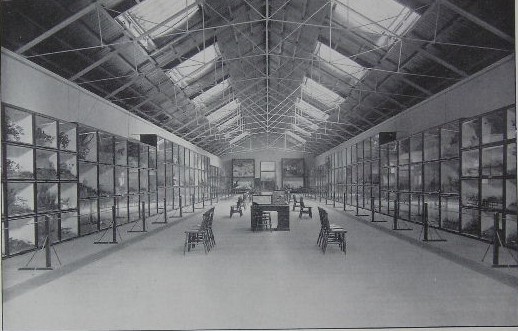
The view inside the museum, as it was around 1911.

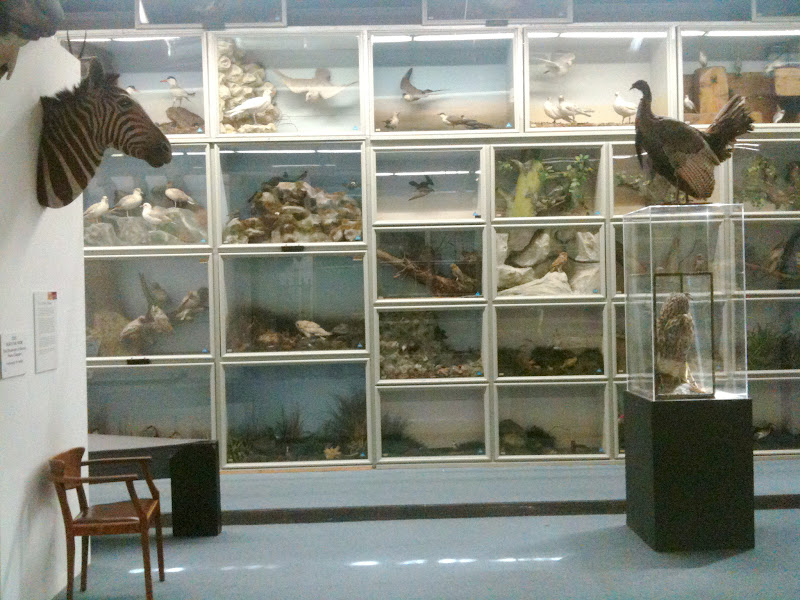
Sorry I didn't take a photograph of the entrance now to compare, the light in the museum is so dim (to preserve the taxidermy) that my Iphone was quite useless, and the next photos aren't exactly brilliant, but hopefully they'll give you an idea of the sheer amount of work in this building! It doesn't look like a large space from the outside, but they sure have made the most of the space! Floor to ceiling cases, some absolutely huge, the top ones housing eagles and vultures which are eating lambs and rabbits...nice! Apart from a new desk and study area, the exhibits look exactly the same as the above picture. Here are a few pictures i managed to take, apologies for the quality!


My favourite bird of the moment! See all the leaves and foliage included? 

Family of Partridges


1. Claire and the giant fish!  2. Fantastic Flamingo!


Painted dioramas in the fossil room

Booth should never be regarded as a commercial taxidermist, as his collection until his death was a private resource. The building itself was built specifically around the collection, some cases even featuring in the walls themselves. Considering I co-own several taxidermy pieces with Bruce, I did find the museum quite overwhelming, all those little bodies peering out into the dim lit room...I don't know why I felt like that, I'm pretty tough! I guess the thought that Booth shot all those birds and animals himself is another factor, he certainly was busy! But it's a true gem in the naturalist movements crown, you won't be stuck in queues to look in the cabinets like at the Natural History Museum, it's much more curious at Booth!  It's a truly unique place to visit and I thoroughly recommend you pop by when you're next in Brighton, especially if its raining cats and dogs like on our trip!

 Myself by the Narwhal/Killer Whale/Dolphin and Indian Elephant specimens. 

Stained glass windows in entrance hall.


Thanks for reading!

Katie